
The 2026 legislative session is over. Here’s what passed and what is already Iowa law
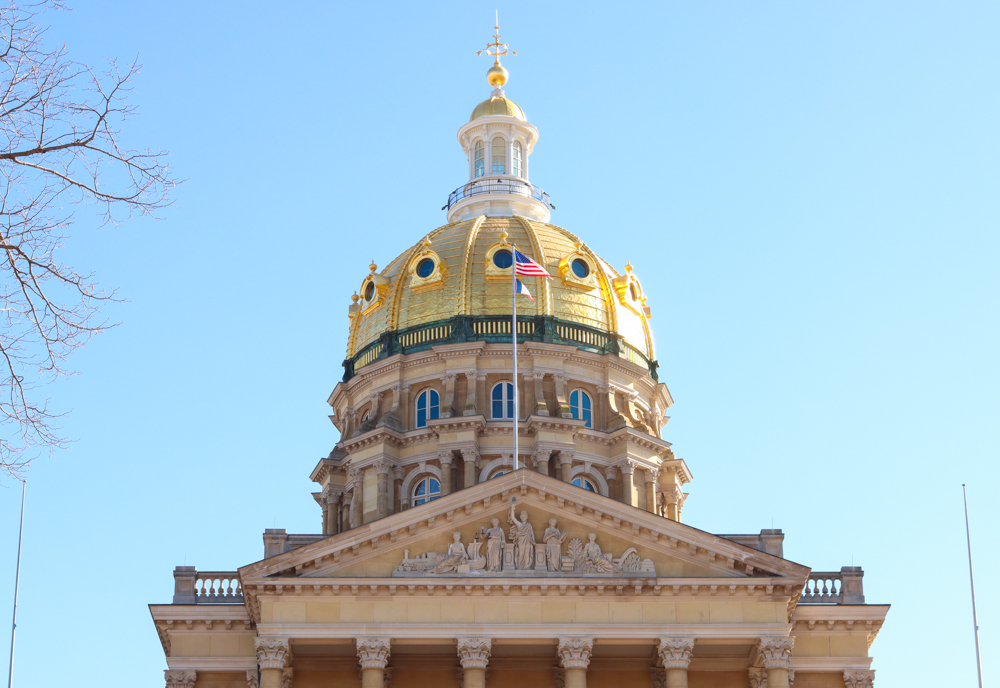
The golden dome of the Iowa State Capitol in Des Moines. PHOTO BY CAMI KOONS/IOWA CAPITAL DISPATCH
DES MOINES – Republican legislative leaders and Gov. Kim Reynolds celebrated the approval of many of their priorities for the 2026 legislative session on issues including property taxes, crime and healthcare as lawmakers wrapped up their work for the year.
Last weekend, lawmakers sent a $9.6 billion state budget to the governor’s desk, as well as legislation restricting access to abortion-inducing medication by requiring the drugs to be prescribed in person.
One of the largest issues legislators found a compromise on in the final hours of the session was property taxes. Reynolds, Senate Republicans and House Republicans had all released their proposals on how to best address high property tax costs in the state early in session, but struggles to find a consensus on the issue was one of the main reasons lawmakers went into overtime after their goal end date of April 21.
Legislative leaders in both chambers said they were pleased with the property tax legislation sent to the governor’s desk Sunday. Senate Majority Leader Mike Klimesh said in a statement he was proud of the Senate Republicans’ months of work in crafting legislation that he says will lower property tax costs.
“Senate Republicans introduced legislation on the very first day to bring overwhelming property tax relief to Iowa homeowners and modernize Iowa’s property tax system,” Klimesh said. “We made great strides in reining in local government spending, reforming the property tax system, and now Iowa homeowners will see billions in property tax relief over the next several years.”
Klimesh also said he was proud of what Senate Republicans passed on a variety of other issues since convening in January.
“At the beginning of the legislative session, I laid out a vision for our state,” Klimesh said. “I wanted to spend our days here focused on growth and investment and ways we can show the world that Iowa is the best place to live, the best place to grow your family, and is open for business. My goal was to have conversations about tax reform, affordable energy, infrastructure and how we can help our state thrive. I am proud we have focused on that vision throughout this legislative session. “
House Speaker Pat Grassley told reporters after ending the legislative session he also believed House Republicans accomplished many of their goals for 2026.
“When we started session, we laid out a few priorities that I think that we made some tremendous strides on,” Grassley said. “Obviously, property taxes … but also looking at some of our ‘tough on crime’ packages and (making) sure Iowa is a safe place … I think there were a lot of the things that we laid out in the beginning of session that we were able to accomplish while this property tax piece kind of hung over everything else.”
One issue that did not make it to the governor’s desk through any legislation was eminent domain, a yearslong priority for House Republicans and top issue for several Senate Republicans. Last year, a group of Senate Republicans had refused to pass budget bills unless an eminent domain bill was debated on the Senate floor.
Eminent domain involves forcing unwilling landowners to accept easements on their property for projects deemed in the public interest for payment set by the government. The Summit Carbon Solutions pipeline across Iowa has been the catalyst for much of the debate.
This standoff did not occur this year, though the group of GOP senators had continued to state their support for bringing the issue up. Grassley said he understood some Iowa landowners’ frustration with the Legislature for not being able to push forward a bill in 2026.
“This is an issue that I really wish we would have been able to make more progress on, but I will only speak on behalf of House Republicans — we’ve tried, probably, I’m guessing, around a half dozen bills to try to find a level of a solution on this issue, to give some certainty to property owners in the state of Iowa. And again, we share your frustration and we’re unable to get something. But that doesn’t mean that that’s something our caucus won’t continue to fight for as we move forward.”
Democrats said many of the measures passed by the GOP-controlled Legislature are proposals that will raise costs for Iowans. Senate Minority Leader Janice Weiner said in a statement the “harm” caused by Iowa Republicans’ policies will not expand after lawmakers leave the Capitol for the year.
She said many of the policies passed this year raised costs for Iowans. Democrats have criticized measures like raising premium taxes for Health Maintenance Organizations as well as the state’s public K-12 education funding package as measures that will lead to higher costs and reduced services across the state.
“Iowans’ healthcare access is shrinking and their premiums are soaring; their monthly budgets are tightening and too many are living paycheck to paycheck; their public schools are unsupported and their childcare costs an arm and a leg,” Weiner said in a statement. “Instead of taking action to provide real, substantial relief on any of the kitchen table issues that truly matter to Iowans, Senate Republicans only made things worse.”
Democrats have also routinely criticized Republicans’ budgeting practices this year. The March Revenue Estimating Conference estimated the state expects to bring in roughly $8.5 billion, less than the $9.6 billion appropriated through budget bills this year, with plans to draw from reserves and the Taxpayer Relief Fund to account for this difference. Republicans have repeatedly stated the loss of revenue was expected as a result of income tax cuts approved in previous years.
But House Minority Leader Brian Meyer said he believes the spending approved this session shows the state budget is “in serious trouble” as lawmakers appropriate more than $1 billion than the state is taking in through revenue.
“That’s kind of scary, because the economy in Iowa and the farm economy especially, is not getting any better, and so we really have to do something to address this problem moving forward, because those reserves will only last two to three more years,” Meyer said.
The 2026 session also marks an important milestone for Reynolds, as it is her final legislative session as governor. In a news release Sunday, she celebrated reaching a deal on property taxes, as well as the Legislature’s passage of policy proposals she laid out at the beginning of session, like her “Make America Healthy Again” proposal, legislation on charter schools and on child care assistance.
She also celebrated the passage of her water quality package, unveiled Friday, that passed as part of the state’s agriculture and natural resources budget in the final days of session.
“Throughout my time in office, the commonsense, conservative policies we’ve enacted will ensure our state remains strong, prosperous, and vibrant for generations to come,” Reynolds said in a statement. “That has been my commitment to Iowans since day one, and I will continue to serve with that same purpose during my final months in office.”
In the coming weeks, Reynolds will be tasked with reviewing and deciding whether to approve legislation sent to her by lawmakers this year. The governor has 30 days from the end of session, June 2, to sign bills from the 2026 session into law.
With the Legislature adjourned for the year, here’s a rundown of some notable bills that made it to the governor’s desk.
Signed by the governor
Childcare assistance: Beginning July 1, Iowa’s Child Care Assistance (CCA) program will become permanently available to parents who are child care workers as the governor signed House File 2514 into law. The measure makes the CCA pilot program that has been in place since 2023 permanent, allowing child care workers to access this assistance program regardless of income.
CDL English tests: Senate File 2426 requires applicants for Commercial Driver’s Licenses (CDL) to pass an English proficiency test in order to receive their license. The test would be administered through a computer-based exam, which only needs to be passed once, and could be taken multiple times. Truck drivers found to not meet English proficiency standards while operating a commercial vehicle would face a serious misdemeanor charge and civil penalty of $1,000 under the bill, and commercial motor carriers found to employ drivers not proficient in English would be subject to a simple misdemeanor charge and a fine of $10,000 for each violation. The measure would also issue an “out of service” order for companies found in violation of the proposed law, preventing the company from operating within the state.
DNR Department bill: House File 2215 allows the Iowa Department of Natural Resources to have offices offsite from the Capitol complex. It also lowers the age a person can hunt with a pistol or revolver without adult accompaniment from 20 to 18, and shifts powers over state preserves to the DNR.
Emissions lawsuits: House File 2527 limits lawsuits against farmers for the “alleged actual or potential” impacts of greenhouse gas emissions on the climate. Proponents for the bill said the legislation would help shield farmers from “frivolous” climate lawsuits.
Foreign ownership of health care facilities: Senate File 572 bans citizens, businesses and government entities from China, Russia and North Korea from being licensed to own and run health care facilities like hospitals and nursing homes in Iowa.
Foster care training: Senate File 2096 makes multiple changes to foster care licensing requirements in the state, including removing current requirements for foster parents to receive 30 hours of training and six hours of additional training annually. Instead, prospective foster parents would have to receive training based on their own “relevant training and experience,” as well as the “circumstances of the child” who would be placed with the prospective parent. Foster parent training under the bill would include an overview of child welfare, biological parent contact and supporting their family of origin, as well as behavior management, the effect of trauma on child development and issues like attachment, grief and loss, and could be administered through approved programs offered by both public or private agencies.
Health insurance premium tax increase for HMOs: House File 2739raises premium taxes on health maintenance organizations, known as HMOs, from the current rate of 0.925% to 3.5% retroactively between Jan. 1 and Sept. 30, 2026. The rate lowers again to 0.95% beginning in October. Health insurance providers offering HMO plans, a type of privately offered Medicaid Advantage plan, said the law will result in higher premiums for Iowans, but Republican lawmakers said the tax hike is needed to cover the Medicaid shortfall caused by the COVID-19 pandemic.
The law also includes a provision moving $89 million from the state’s general fund to the Iowa Department of Health and Human Services for the state’s Medicaid program to address the shortfall in FY 2026, and transfers almost $350 million from Iowa’s Taxpayer Relief Fund to make up for revenue loss from tax cuts made at the federal level in 2025.
Local civil rights codes: Senate File 579, signed by Reynolds March 10, restricts local governments from implementing civil rights protections for groups not listed as protected classes under the state Civil Rights Act. Democrats called the bill an expansion of the 2025 law removing “gender identity” from the state civil rights code, saying it targets the 14 Iowa cities, as well as unincorporated areas of Johnson County, that have enacted local protections on the basis of “gender identity.”
Local identification cards: Local governments are also no longer allowed to issue community ID cards under measure signed into law by Reynolds. House File 2296 would specifically impact Johnson County’s community ID program, which lawmakers said is a program that aids law enforcement officers and first responders when a person does not have a driver’s license or nonoperator ID. Counties are still allowed to issue forms of ID like driver’s licenses, nonoperator’s identification cards and identification devices for persons with disabilities under the law, and local governments can still issue employee IDs.
Repealing state-mandated programs: House File 2359 would repeal state-mandated higher education programs like the College Bound program, Minority and Women Educators Enhancement Program and others. Reynolds signed the bill April 30.
Shellfish: A bill would create an individual category for shellfish in Iowa’s animal feeding operation code. House File 2534 adds shellfish as a separate category to the state definition of animal feeding operations, allowing for the regulation of shellfish producers in the state.
Subacute mental health care: House File 2543, passed unanimously through both chambers, aims to improve access to subacute mental health care – in-person, intensive mental health treatment for individuals who are not at high enough risk to need emergency hospitalization. The measure was brought up in response to suggestions made during a January Subacute Mental Health Care Services Interim Study Committee.
House lawmakers from both parties, as well as Senate Democrats, said they preferred the version of the bill passed by the House in March, which eliminated a current 10-day limit in state code for receiving subacute mental health care unless HHS gives approval for a longer period of stay. It also would have banned preauthorization requirements for a person to be admitted and receive care for the first 15 days of treatment at subacute mental health care facilities, and restricted when Managed Care Organizations could review the “medical necessity” of this treatment. Senate Republicans significantly changed this proposal, removing the language related to insurers and MCOs, and instead setting new requirements for HHS to respond to insurance authorization requests. Though some lawmakers expressed consternation about the Senate amendment, lawmakers agreed the change would still improve Iowans’ ability to access subacute mental health care.
Transmission lines in interstate right-of-ways: Senate File 2214 allows for transmission projects to be built in interstate right-of-ways, requiring the state Department of Transportation to engage in conversation with transmission line operators on potentially using highway and interstate easements.
Transmission line land restoration: House File 2227 requires electric transmission line owners to repair tile drains, till impacted soil and reseed cover crops or other ground cover after the initial construction of electric transmission lines in easement areas.
Transmission line safety plans: Transmission line operators will also be required to submit independent emergency response plans to the Iowa Utilities Commission under House File 2583. This requirement will ensure other entities involved in Iowa’s electric grid “abide by the same rules and laws as our electric utilities,” Rep. David Young, R-Van Meter, said.
Veteran tuition waiver: House File 2491, which saw unanimous support from the House and Senate before being signed by Reynolds, establishes a tuition and fee waiver for veterans with a 100% disability rating from their service as defined by the U.S. Department of Veterans Affairs.
Local News

Local history finds new home at The CEC

One, Two, Done: Last week’s Tama County Supervisors meeting

Gladbrook house fire continues to be investigated

Iowa All Breeds Jeep and 4×4 Show returns to Oak Ridge MX Park

SBA administrators present $5 million workforce training grant to Iowa Valley Community College District
