
Touring the Skies By Jim Bonser (jbonser@usa.net)
Ps. 19-1 The heavens declare the glory of God; the skies proclaim the work of his hands.
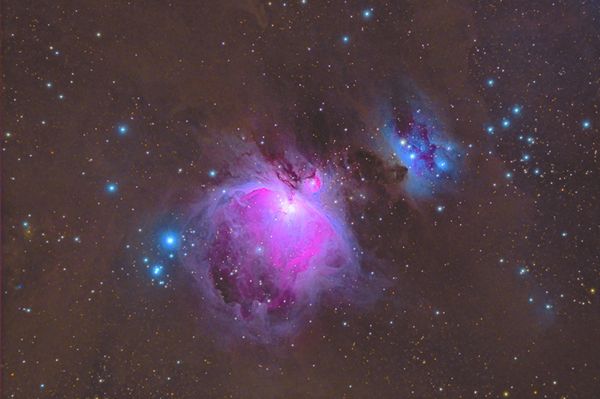
Even though I wrote last month that Spring for the Northern Hemisphere began on Thursday, March 19, I woke up from my Sunday afternoon nap and looked out the living room picture window in horror at a snow covered lawn, and snow falling so heavily that I could barely make out the farm about ? of mile to the west! I’m hoping that April will not disappoint us this year and provide plenty of cool but not cold, clear nights to enjoy the wonderful spring constellations. As the days get longer and sunset gets later, the star of the winter skies: Orion, quickly disappears into the evening twilight. At the beginning of the month Orion may be seen in the southwest driving Taurus the bull behind the haze at the horizon around 9 P.M. But if you go out at the same time on the 18th, you will be challenged to pick out the three stars in his belt which are now just 20 degrees or so from the horizon in the west-southwest. Venus will help you locate Orion as his stars become harder and harder to pick out of the dusky skies. Bright Venus is easy to spot above the western horizon all month. Pay attention in the early days of the month to its relationship to the Hyades or ‘face of the bull’ of Taurus to the left and then continuing a bit farther past the Hyades the three stars of the belt of the hunter: Orion. Remembering this progression will help you later in the month as twilight begins to hide the stars more and more. Venus makes a lovely pass by the 7 sisters or Pleiades this month. Every 8 years, Venus passes close by the Pleiades in April. This year they rendezvous on April 3rd. On the evening of April 2nd, Venus will be about a half of a degree below the bowl shaped center of the cluster and the next night, the dazzlingly bright planet will park just under the short ‘handle’ of the dipper asterism made by the brightest members of this wonderful open cluster. It will be beautiful! I hope we’ll have a clear night so we can enjoy it! As Orion exits to the western horizon, Leo approaches center stage in the southeast. Leo is a very big constellation and to me at least, very much resembles the lion it is supposed to represent. After admiring Venus in the southwest, turn and face the southeast and look up about 60 degrees. That’s about 2/3rd’s of the way from the horizon to straight overhead. There you will see the bright blue-white star named Regulus. I remember that by thinking of the Regal King of the Beasts: Leo the lion. On April 3rd when Venus is visiting the Pleiades, the Moon will be visiting Leo, just below his chin. On the 4th, the bright gibbous Moon will be just under 5 degrees to the left of Regulus. Be sure to keep turning and face towards the northeast where you might be a little surprised to see the Big Dipper with its handle pointed straight down to the ground and the bowl high in the sky! Not the normal way we are used to seeing the dipper! All the other bright planets remain in the predawn skies. In the middle of the month, our friendly guide, the Moon will help identify each of the three which are lined up in a nice neat row. If you happen to be out about 4 A.M on April 14th (I probably won’t), a bright, waning gibbous Moon will arrive just to the right of the King of Planets: Jupiter. The next morning, the Moon will have passed Jupiter and will be below and to the right of golden Saturn. Finally, on April 16, the Moon will be below and a little to the left of mysterious Mars. You might have to wait until a little after 4, say 4:10 or 4:15 for the Moon to rise above the horizon for this one. Finally, I want to mention that the Lyrid meteor shower. This meteor shower is spread out over several days from April 16 to 25. It is predicted to peak this month, in the wee hours of the morning of April 22nd. Fortunately, the Moon will be waning crescent just a day from New Moon on the 22nd so it will not be a problem this year. According to Earthsky.org, “About 10 to 15 meteors per hour can be expected around the shower’s peak, in a dark sky. The Lyrids are known for uncommon surges that can sometimes bring the rate up to 100 per hour.” The Lyrids are also famous for producing dazzling fireballs. If it warms up enough this month, who knows? I just might be tempted to dust off the reclining lawn chair, pull on my snowmobile suit and try to stay awake watching for some. Lyra, where the meteors radiate from will be high overhead in the early morning skies, so it won’t really matter which direction you look. Try to put any glow from city lights behind you and just scan the darkest part of the sky for you and enjoy the show! Clear Skies!
Local Columns

Dengler Domain: Taking Advantage

Laity Reflection: How Do We Know the Bible is True?

Heather’s Highlights: County Government and You, August 2026

Pastor’s Corner: Enter The Narrow Gate

On Nature: New Climate Technologies