
In the Sky: Finding October’s Queen
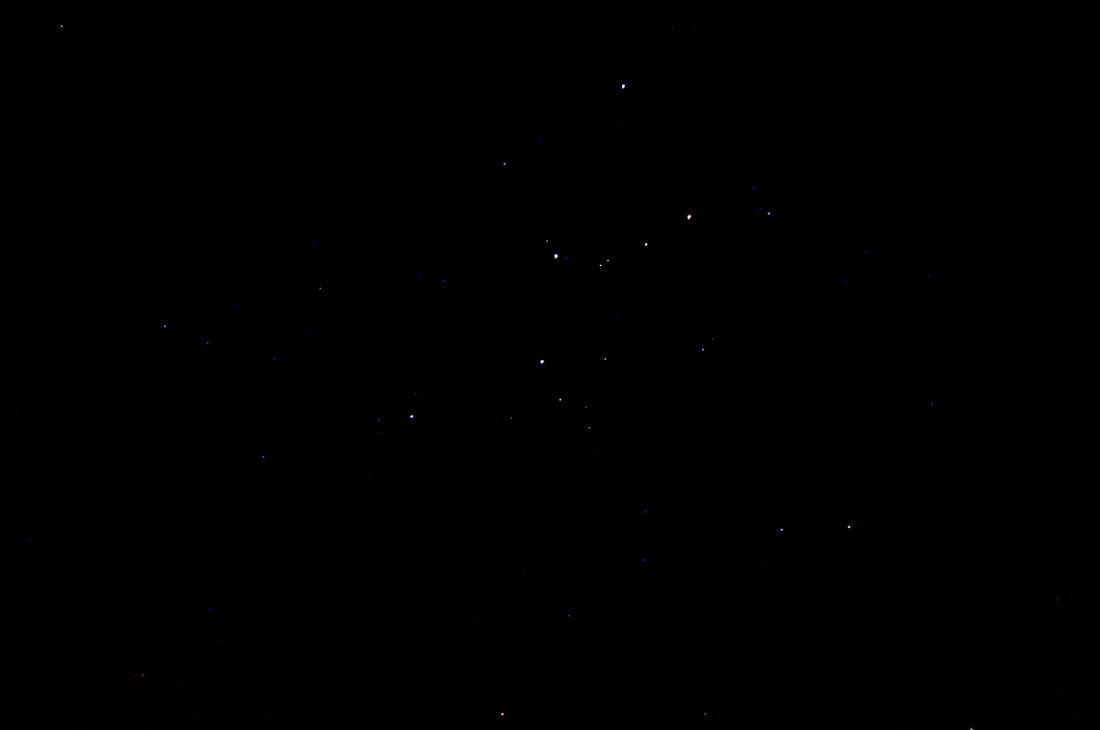
An enhanced photograph the author took of Cassiopeia.
October will be a special month in the sky. Cassiopeia (the Queen), one of the most prominent constellations and one of the best sights in astronomy, will be well positioned for viewing in the northeastern sky. Its five brightest stars form an unmistakable zigzag that looks like a stick figure 3 during October evenings. Cassiopeia is circumpolar, like the Big Dipper, and continually circles Polaris, the North Star. It also can be used to find north. The open part of the constellation points generally toward the North Star, and since there are no bright stars in the area, the first fairly bright star you come to will be the North Star. Also, since Cassiopeia is on the opposite side of the North Star from the Big Dipper, it is particularly useful in finding north during late autumn when the Big Dipper is very low or even below the northern horizon from the southern states and Cassiopeia is high in the sky and looking more like an M.
The topmost star of Cassiopeia is Caph, and it leads the rest of the constellation around the North Star. When discussing Cassiopeia, it is helpful to number the five brightest stars with Caph being star 1. A line from star 2 through star 1 will point a short distance to the dim constellation Cepheus (the King), the husband of Cassiopeia. Cepheus looks like a five-stared stick figure of a house. The peak of the roof is always near the North Star, so during October evenings, it will be upside down.
A line from Cassiopeia’s star 3 through star 4 will point to the constellation Perseus (the Hero), whose large number of reasonably bright stars look like a ragged letter K. Half way between Cassiopeia and the closest stars of Perseus is the “double cluster” of two close-together open star clusters that can be seen with the naked eye or binoculars if the sky is dark.
Also, there is a star almost on the line from star 2 to star 3 that is nearly a twin to our Sun. If you were on a planet around this star, the Sun would look dim, like it looks to us. However, the Sun’s twin is also a binary star with a dim companion.
The only planet that will be visible all night during October is Saturn, and it will be unmistakable in a dim part of the sky as it rises before it is dark and passes through the southern sky during the night. Mars and Jupiter will rise after midnight. Venus and Mercury will be too close to the Sun to be seen.
Observing Highlights
-Oct. 5: After they rise at about 3:00, the Moon will be close below reddish Mars and very close above the Beehive open star cluster. Very bright Jupiter will be below them, and the bright twin stars of Gemini (the Twins) above.
-Oct. 6: The Moon will pass over or occult Jupiter in the early morning. In central Iowa, the Moon will cover Jupiter from about 3:21 until about 4:16. Since the Moon will rise at about 2:43, the occultation will start very low in the eastern sky. Times will differ in other places, but the eastern states will see the entire event higher in the sky. Observers in the west will miss the occultation, but they will see the Moon very close to Jupiter after they rise.
-Oct. 8-11: Iowa Star Party, Whiterock Conservancy, Coon Rapids, $60.00. Free public viewing on the 10th.
-Oct. 11: Before dawn, Mars will be very close to or within the Beehive open star cluster. Visible with binoculars.
-Oct. 14: The crescent Moon will be close to the lower left of bright Antares in Scorpius (the Scorpion) at nightfall.
-Oct. 19: The Moon will be within the dim constellation Capricornus (the Sea Goat). On the 20th, The Moon will be just above the constellation’s brightest star Deneb Algedi. The Moon probably will be too bright to see Capricornus, but if you mark the Moon’s location, you will know where to find the constellation. It resembles a wide, flat triangle with Deneb Algedi in its left corner. To modern observers, it resembles the bottom of a bikini bathing suit.
-Oct. 23: The Moon will be to the upper right of Saturn. The Moon will move in its orbit and be left of Saturn on the 24th.
-Oct. 27: The Moon will lead the bright star Aldebaran in the constellation Taurus (the Bull) into the sky at about 8:00.
Local News
Tama County Historical Society’s ‘Get to Know the Museum Night’ Oct. 14
TOLEDO – The Tama County Historical Society invites the public to come see what’s new at the Tama County Museum ...
In the Sky: Finding October’s Queen

Rob Sand stumps for a different view in Iowa

Tama County deputy arrested, charged with OWI in Grundy County

GOP Congressional candidate Joe Mitchell visits Tama County
