
Gladbrook Junior ALA members assist with community Flag Day program
- Kinley Miller (left) and Alaney Sienknecht (right) present a flag to Gladbrook ALA member Janel Gienger. PHOTO COURTESY OF JEANNE PAUSTIAN
- From left, Junior Auxiliary members Emma Bauer, Alaney Sienknecht and Kinley Miller. PHOTO COURTESY OF JEANNE PAUSTIAN
- Americanism Chair Lisa Reinhard holds the first American flag of the 13 colonies. PHOTO COURTESY OF JEANNE PAUSTIAN
- Junior Emma Bauer (right) presents the U.S. flag to Westbrook Acres Administrator Beth Brubaker. PHOTO COURTESY OF JEANNE PAUSTIAN
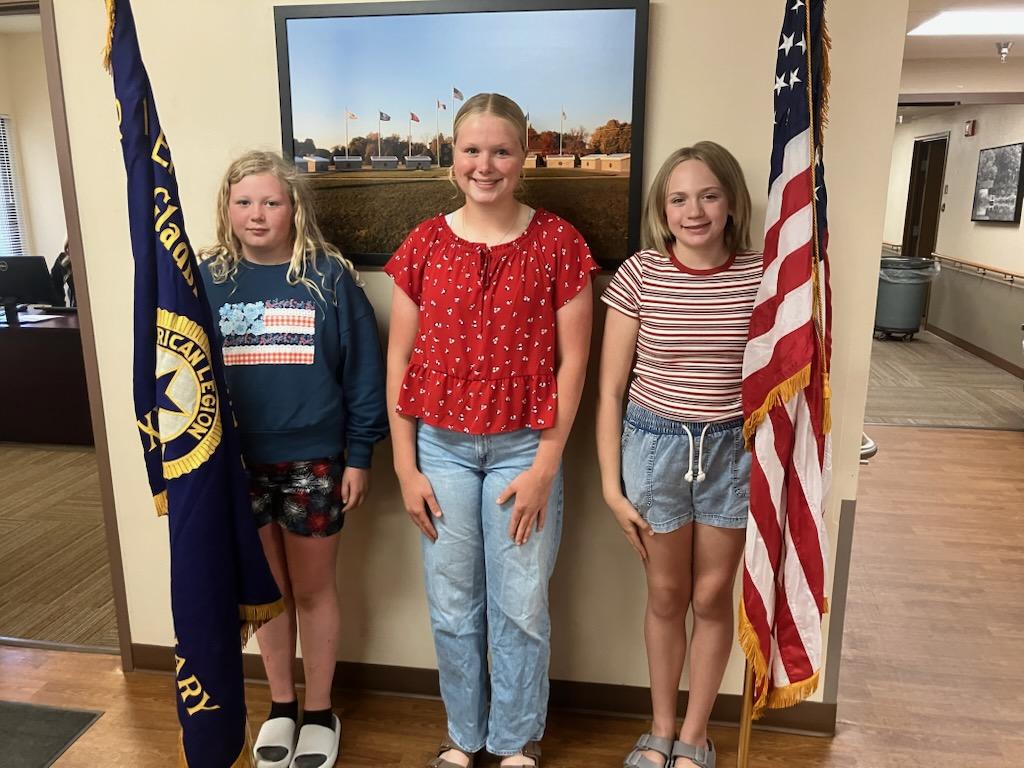
From left, Junior Auxiliary members Emma Bauer, Alaney Sienknecht and Kinley Miller. PHOTO COURTESY OF JEANNE PAUSTIAN
GLADBROOK – The Gladbrook American Legion Auxiliary and Jr. Auxiliary hosted a Community Flag Day Program at Westbrook Acres on Monday, June 15. Juniors Alaney Sienknecht and Kinley Miller passed out little American flags, and Caden Savage passed out the songbooks. Pianist Sue Koster played several patriotic hymns before the program began.
Gladbrook American Legion Auxiliary Americanism Chair Lisa Reinhard welcomed everyone to the program. The colors were advanced by Alaney and Kinley, followed by the Pledge of Allegiance and the national anthem.
Chair Reinhard’s speech: Betsy Ross/Francis Hopkinson
This year, I decided to talk about Betsy Ross. From past research, I knew that there were discrepancies that Elizabeth Griscom Ross Ashburn Claypoole, better known as Betsy Ross, designed and made the early flag we know as the Betsy Ross flag. I thought research would uncover more positive information but I was wrong.
What we know is Betsy Griscom was born into a Quaker family. After completing her education in Quaker school, she was apprenticed to work in the upholstery business. She met her first husband, John Ross, and married in 1773 at age 21. She was expelled from the Quaker congregation as her husband was Episcopalian. John died in 1776 in a gunpowder explosion.
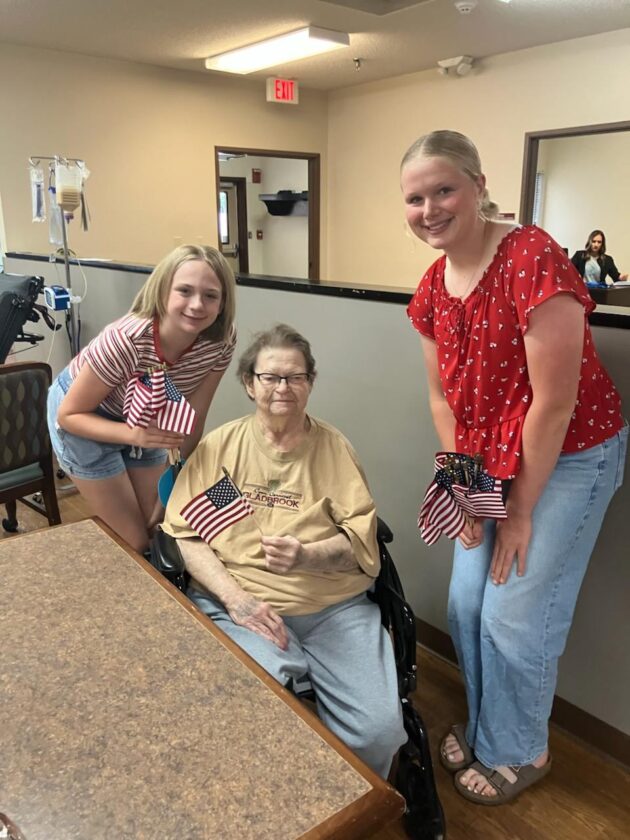
Kinley Miller (left) and Alaney Sienknecht (right) present a flag to Gladbrook ALA member Janel Gienger. PHOTO COURTESY OF JEANNE PAUSTIAN
A year later, she married Joseph Ashburn. He was captured by the British during the American Revolution, charged with treason, and died as a prisoner of war in Britain in 1782. Betsy was pregnant at the time and also lost a 9-month-old daughter while Joseph was in captivity.
She married John Claypoole in 1783; he had been imprisoned with Joseph and had delivered the news of his death to Betsy. They were married for over 30 years and had five daughters together.
It was nearly 100 years after the supposed meeting with members of the congressional congress, including George Washington, that the first suggestion of Ross designing the flag was put on paper. Betsy’s grandson presented a paper to the Historical Society of Pennsylvania claiming that Betsy told one of her daughters that she designed the flag. However, there are no documents or witnesses to corroborate this; only a family story passed through the ages.
During the 1893 World’s Fair, the flag legend became widespread. It was promoted through a painting by Charles Weisberger entitled, The Birth of Our Nation’s Flag, which depicts Ross presenting her flag to George Washington. During this time, the suffragette movement was starting and there was a need for female heroes. The flag became a symbol of unity and the Betsy Ross story flourished.
Weisberger went on to raise money to buy and preserve the Betsy Ross House in Philadelphia. It is now believed that the house next door to this house was actually the house that Betsy and her family lived in. That house was torn down to allow more room for tourism.
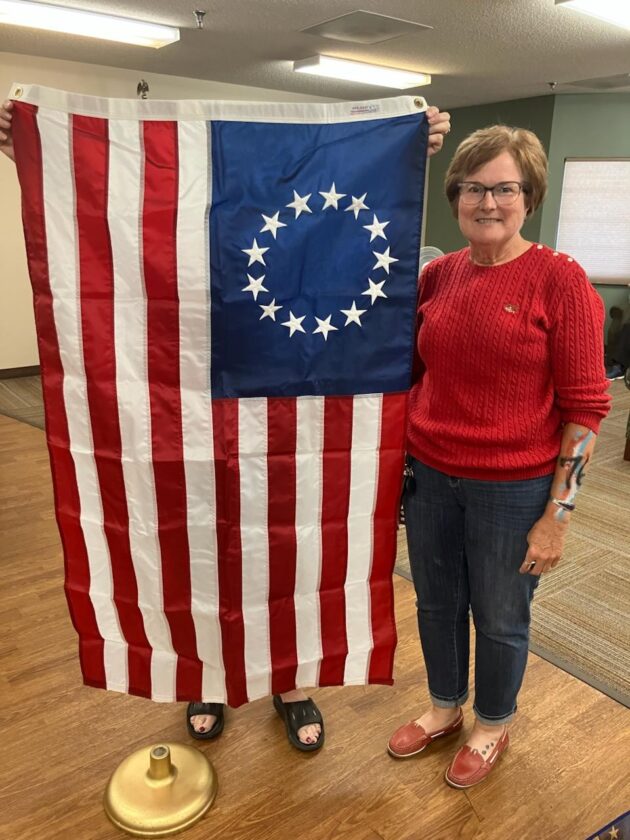
Americanism Chair Lisa Reinhard holds the first American flag of the 13 colonies. PHOTO COURTESY OF JEANNE PAUSTIAN
In addition to Betsy’s tragic life circumstances, she was buried/reburied three times. First, she was buried next to her third husband. Twenty years later her body was exhumed and reburied to make room for city growth. And in 1975, in anticipation of the bicentennial, her remains were moved to the courtyard of the Betsy Ross House.
There were many talented seamstresses in Philadelphia in the 1770s. So, while Betsy was definitely a skilled seamstress and was probably involved in sewing early American flags, historians agree she did not create the iconic flag that we know.
Historians do give Betsy credit for suggesting a five-point star over the six-point star that was being used on flags. Six-point stars were widely used by the Masons, of which George Washington was a member. Ross is credited with showing how one cut could make a perfect five-point star.
So, who designed the Betsy Ross flag? Most historians credit Francis Hopkinson as the designer of the American flag. He signed the Declaration of Independence, was a delegate in the Continental Congress, a lawyer, a poet, musician, and an artist. He designed seals for the U.S. Treasury and the state of New Jersey as well as U.S. currency.
There is written evidence suggesting that he worked on the American flag design around 1776. According to the National Postal Museum, Hopkinson wrote a letter in 1780 requesting compensation for designing “the flag of the United States of America,” the Great Seal of the United States, and other items. His desired payment was a ‘quarter cask of the public wine.’
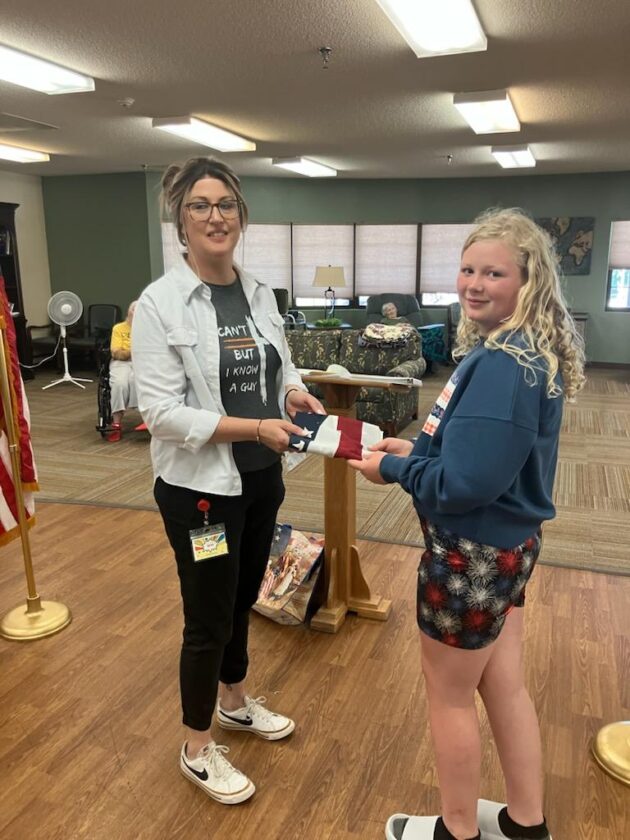
Junior Emma Bauer (right) presents the U.S. flag to Westbrook Acres Administrator Beth Brubaker. PHOTO COURTESY OF JEANNE PAUSTIAN
Journals from the Continental Congress also indicate he designed the flag. Requests for payment were repeatedly denied due to two reasons. It was claimed he wasn’t the flag’s sole designer so he shouldn’t receive all the credit. Additionally, it was felt that the affluent Hopkinson owed his service to the public and the flag was his contribution.
Hopkinson’s gravestone in Philadelphia outlines many of his accomplishments and includes the phrase ‘designer of the American flag.’
Program conclusion
Following Chair Reinhard’s speech, everyone enjoyed waving their little flags and singing “It’s a Grand Old Flag” and “America the Beautiful.” Junior Emma Bauer presented a new American flag to Westbrook Acres Administrator Beth Brubaker.
After the retirement of the flags, everyone joined hands and sang “God Bless America.”
Bars and Jell-O cake was then enjoyed by all.
Local News
Local history finds new home at The CEC

One, Two, Done: Last week’s Tama County Supervisors meeting

Gladbrook house fire continues to be investigated
Iowa All Breeds Jeep and 4×4 Show returns to Oak Ridge MX Park
SBA administrators present $5 million workforce training grant to Iowa Valley Community College District

COMMENTS
[vivafbcomment]