Lawmakers seek to standardize county regulation of renewable energy facilities
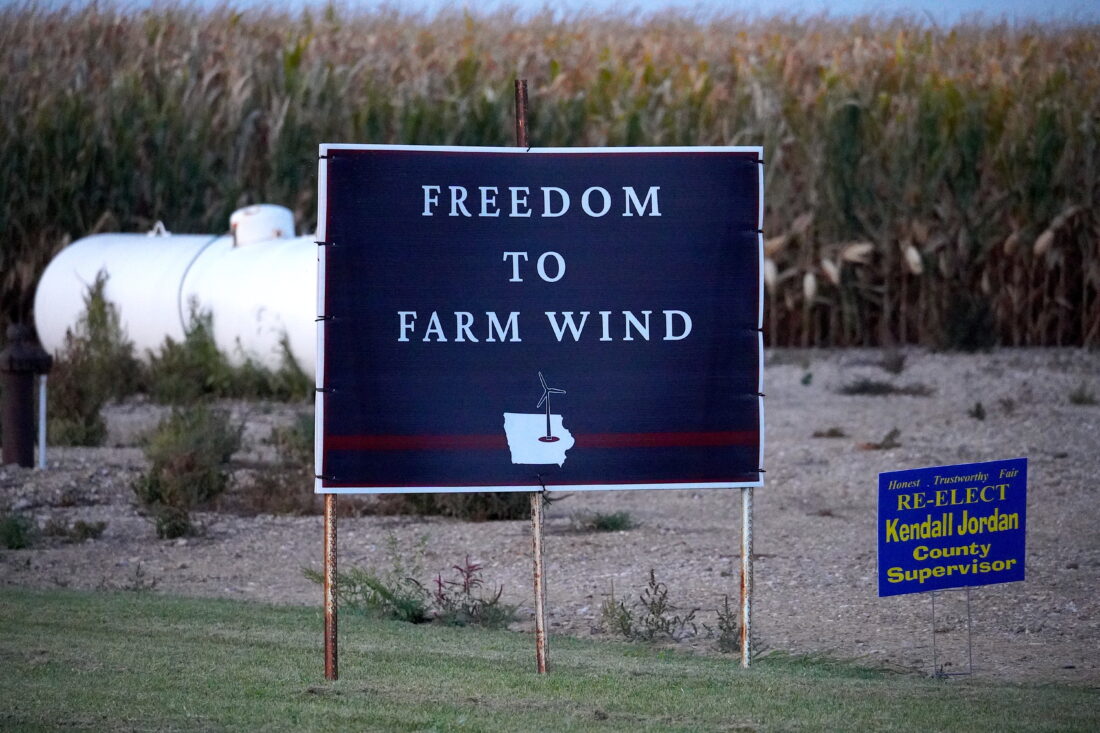
A 'Freedom to Farm Wind' sign located along US 63 in the footprint of Salt Creek Wind Phase I. PHOTO BY RUBY F. MCALLISTER
DES MOINES – A House subcommittee advanced a bill Wednesday, Feb. 11, that would create standard language for counties to adopt pertaining to setbacks, moratoriums, property tax and other siting considerations for renewable electric power generation facilities.
Rep. Shannon Lundgren, R-Peosta, who chaired the committee, said the bill would help renewable energy developers know that “we are open for business here in the state of Iowa” which she said is essential to meet energy demands in the state.
“The state is charged with making sure that we are generating enough electricity and that we don’t see the rolling brownouts and blackouts that other states have,” Lundgren said. “When we have counties that close the door for us to do what we need to do as state legislators, that really causes concern.”
Included in House Study Bill 692 is a clause that eminent domain will not be used to acquire rights of way for the construction or operation of any renewable electric generation facility, which includes: battery energy storage systems, solar energy conversion facilities and wind energy conversion facilities.
The bill would allow local authorities to determine things like setback standards, shadow flicker standards and sound limitations, but only within certain ranges set by the bill. For example, setback limitations for wind energy conversion facilities cannot be more than three times the total height of the wind turbine between the turbine location and an abutting dwelling. A sound limitation cannot be more restrictive than a 47-decibel maximum for wind energy facilities.
Dustin Miller, speaking on behalf of the American Clean Power Association and the Clean Grid Alliance, was in favor of the bill and said that currently, more than 50 counties in the state have initiated moratoriums or restrictive ordinances for renewable energy projects.
“We’re having three- to five-member boards of county supervisors making energy policy decisions in the state that they’re not equipped to do,” Miller said. “And certainly they’re listening to their constituents, however, it isn’t just affecting things that have gotten a little more hyperpolitical, wind, solar, battery.”
Miller said now these local policies are bleeding over into issues like restarting a nuclear power plant, or dealing with natural gas and thermal resources.
“Ultimately, with the grid strain that we’re seeing, something has to be done, from an energy policy standpoint, to step into this,” Miller said.
The bill would still allow counties to place one, temporary moratorium for up to six months on new wind energy projects.
HSB 692 states that it does not require local authorities to adopt “standards for approval” of renewable electric power generation facilities.
If the bill is enacted and local authorities have moratoriums or conflicting ordinances in place, the counties must either amend their standards or send notice to all taxpayers in the jurisdiction of the “amount of estimated property tax revenue” that has not been received by the local authority as a result of the moratorium on renewable energy projects. The counties must also hold a public hearing explaining the reasoning for the moratorium or conflicting standards.
Claire Simmons, speaking on behalf of Power Up Iowa — a coalition of renewable energy supporters — spoke in favor of the bill and said as counties put ordinances or moratoriums in place, some counties that “are desperately needing new tax revenue” are blocking “significant investments.”
Kevin Kuhle, representing Iowa Farm Bureau Federation, which was the only organization registered opposed to the bill, said analysis from Farm Bureau found that counties have not always “passed along” the tax revenue increases generated from these projects, to reduce taxes for property owners in the region.
Kuhle said Iowa Farm Bureau members support state standards that “don’t preempt county ordinances” and feel strongly that minimum standards in the bill should also take into account projects that are built on agricultural land.
The bill stipulates that local authorities cannot add ordinances that prohibit renewable energy generation facilities from being developed on agricultural or industrial zoned land, nor can they prohibit projects based on the corn suitability ratings of a site.
The Iowa State Association of Counties and Iowa State Association of County Supervisors registered undecided on the bill, but the group’s lobbyist, Lucas Beenken, said the development of these projects and related ordinances is an issue that is frequently brought up by county supervisors as a concern.
“At the end of the day, no surprise, local control is the issue,” Beenken said.
He said the bill is “a really good approach” though he suggested lawmakers also speak with counties to determine what works best for their area.
Rep. David Young, R-Van Meter, said the ultimate local control is the landowner, and these voluntary projects could give willing landowners some “great added income.”
“I want to send the message that we are open for business here in Iowa, especially in rural Iowa,” Young said.
Young, Lundgren and Rep. Kenan Judge, D-Waukee, signed on to advance the bill to the full House Commerce Committee.
Telegraph Note: On Feb. 16, the bill advanced from the House Commerce Committee and was subsequently renumbered as House File 2580. Later that week, the legislation survived the first “funnel” deadline of the 2026 legislative session.
Local News
The Pie Lady brings down the house – and feeds it, too

Inaugural ‘Traer Quilt Experience’ unfolds March 21

Fisher not supportive of bills removing vaccine requirements By Lana Bradstream

Gladbrook Community Calendar
Clarification: Dysart home to clinic, dentist
In last week’s story “Public Health budget takes center stage at supervisors meeting,” Tama County Public ...